
The Difference Between Investors Who Close Deals and Those Who Don’t Has Nothing to Do With the Market. It’s All In the Mind.

Success in the commercial real estate sector is frequently attributed to external variables: interest rate fluctuations, inventory levels, or macroeconomic policy. However, an objective analysis of transaction volume across various market cycles reveals a consistent pattern. Certain investors maintain a high closing rate regardless of volatility, while others remain stagnant even during periods of extreme liquidity. This divergence is rarely a product of the market itself. It is a direct result of the psychological infrastructure and mental discipline of the investor.
The distinction between a perpetual observer and a closer lies in the ability to decouple internal decision-making from external market noise. While the market provides the environment, the mind provides the strategy. For the serious investor, the objective is not to wait for the perfect market, but to cultivate the mental state required to identify and execute deals within any market.
Define the Market Paradox
Market conditions are neutral data points. High interest rates represent a cost of capital; low inventory represents a supply-demand imbalance. These are facts, not barriers. The paradox of real estate investing is that some of the most significant portfolio growth occurs during periods of maximum uncertainty.
Investors who fail to close often suffer from “analysis paralysis” or “cyclical anchoring.” They fixate on past market conditions, such as the sub-3% interest rates of previous years, and refuse to adjust their underwriting to current realities. Conversely, those who close deals understand that the “market” is a collection of fragmented opportunities. They do not wait for the market to change; they change their approach to fit the market. This shift requires a transition from a reactive mindset to a proactive, data-driven methodology.

Establish Mental Discipline and Underwriting Rigor
The foundation of a closer’s mindset is the commitment to rigorous, unemotional underwriting. Closing a deal is the final step in a long process of rejection. A successful investor may review dozens of property types and financing structures before finding a single viable transaction.
Mental discipline involves sticking to pre-defined investment criteria. It is the ability to say “no” to a deal that almost works. Investors who struggle to close often lack this discipline, leading them to chase marginal deals out of a fear of inactivity or “FOMO” (Fear Of Missing Out). A professional investor treats every deal as a mathematical equation. If the numbers do not meet the internal rate of return (IRR) or debt service coverage ratio (DSCR) requirements, the deal is discarded without emotional residue.
Leverage Strategic Partnerships
No investor operates in a vacuum. The ability to close deals is heavily dependent on the quality of one’s professional ecosystem. This includes attorneys, property managers, and, most critically, expert financing brokers.
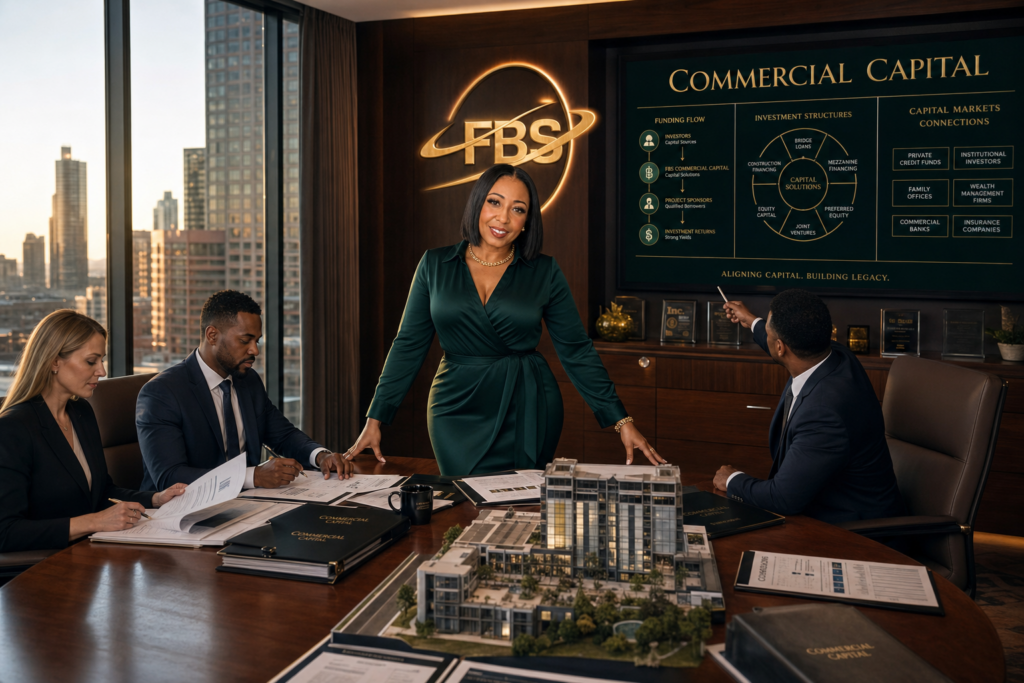
FBS Commercial Capital serves as a certified national private money broker, providing the strategic bridge between an investor’s vision and the capital markets. The difference between a closer and a non-closer often comes down to who they have in their corner. A professional broker does not just provide a rate; they provide a structure. They understand the nuances of private money loans and can navigate complex scenarios that traditional banks might reject.
By partnering with an expert broker, investors gain access to a broader range of solutions, including:
- Bridge Loans for rapid acquisitions or stabilization.
- Hard Money Loans for time-sensitive or opportunistic plays.
- Construction Loans for ground-up development or major renovations.
- Non-Recourse Loans to protect personal assets in large-scale transactions.
The closer recognizes that they do not need to be an expert in every facet of lending. Instead, they master the art of leveraging the expertise of others to maintain agility.
Utilize Agile Financing Solutions
The “mindset of the closer” is one of speed and certainty. In competitive markets, the ability to provide a proof of funds or a quick commitment letter is often more valuable than the purchase price itself. This is where specialized financing tools become essential.
Master the Bridge and Hard Money Advantage
For many investors, the hurdle to closing is the rigidity of traditional bank financing. Conventional lenders often have lengthy “box” requirements that do not account for the complexities of value-add real estate. Investors who close deals frequently utilize bridge loans to secure a property quickly, allowing them time to renovate, lease up, or stabilize the asset before moving into long-term commercial refinance options.
Similarly, hard money loans are viewed not as a “last resort,” but as a strategic tool for high-velocity investing. The closer understands that the slightly higher cost of capital is a small price to pay for the ability to capture an underpriced asset that would otherwise be lost to a more agile competitor.
Explore Non-QM and Stated Income Options
The mental shift also involves exploring creative financing paths. For self-employed investors or those with complex tax returns, traditional income verification can be a bottleneck. Utilizing Stated Income / Stated Asset loans or Non-QM (Non-Qualified Mortgage) products allows the investor to focus on the cash flow of the property rather than the personal debt-to-income ratios that hinder traditional lending.
Maintain Emotional Neutrality
The commercial real estate market is prone to cycles of irrational exuberance and excessive pessimism. The investor who closes deals remains tethered to reality through emotional neutrality.
When the market is “hot,” they resist the urge to overpay. When the market is “cold,” they resist the urge to hide. This neutrality is achieved through a focus on the fundamental “why” of the investment. Is the goal long-term wealth, immediate cash flow, or portfolio diversification? By keeping the primary objective in focus, the investor can ignore the emotional swings of the broader market.

Implement a Systematic Approach
To move from the mindset of an observer to that of a closer, an investor must implement a structured workflow. Preparation is the antidote to hesitation.
Develop a robust “Buy Box”
Define specific geographic locations, asset classes (e.g., Multi Family, Retail, or Self Storage), and minimum return thresholds. Having a written “buy box” reduces the cognitive load of decision-making and allows for faster evaluation of incoming deals.
Standardize the underwriting process
Create or utilize a standardized model for every deal. This ensures that every transaction is judged by the same objective criteria, preventing “deal creep” where requirements are lowered to justify a poor investment. Review the commercial loan forms and business debt schedule requirements early to understand exactly what information is needed for a smooth closing.
Build the financing pipeline in advance
The most successful investors do not wait until they find a deal to talk to a broker. They establish a relationship with a partner like FBS Commercial Capital beforehand. This allows the broker to understand the investor’s track record, financial position, and goals. When a time-sensitive opportunity arises, the infrastructure for funding is already in place.
Review eligibility requirements
Understand the difference between various loan types. Whether it is a Bridge Loans or Construction Loan, knowing the eligibility requirements in advance prevents wasted effort on unworkable structures.
Execute with conviction
Once a deal passes the underwriting and the financing is structured, the final step is execution. The closer acts with conviction because they have done the work. They trust their systems, their data, and their partners.
The difference between those who close and those who don’t is ultimately found in the gap between knowledge and action. Many people know how to analyze a market; very few have the mental fortitude to act when the analysis indicates an opportunity, particularly when the consensus is one of fear. By focusing on mental discipline, leveraging expert brokerage services, and maintaining an agile approach to financing, an investor transforms from a participant in the market to a master of it.
Traci Noel | Founder, FBS Commercial Capital


